



As the core material of the battery system, the positive electrode material of lithium sodium ion batteries plays a crucial role in determining the energy density, power characteristics, and cycle life of the battery. It requires high specific capacity, good ion conductivity, and structural stability. At present, the positive electrode materials of zinc sodium ion batteries still face many challenges such as structural collapse during charging and discharging, rapid capacity decay, and poor rate performance, which have great room for improvement.
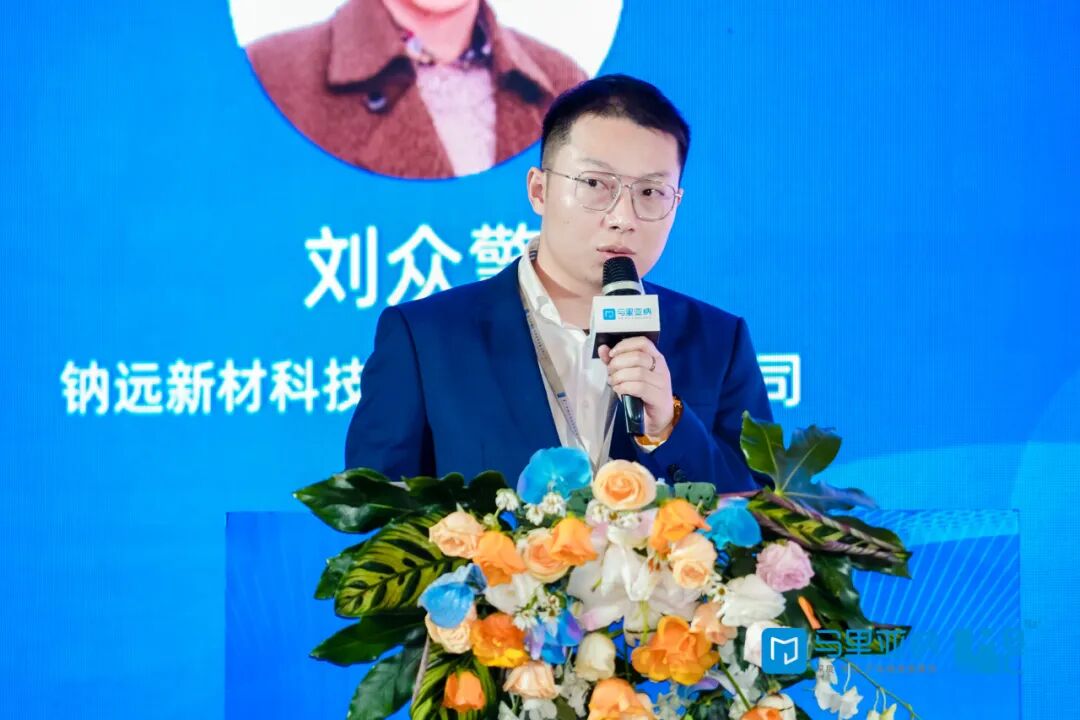
In response to the series of challenges faced by the positive electrode materials of lithium sodium ion batteries mentioned above, Dr. Liu Zhongqing and his research team from Na Yuan New Materials, together with Southern University of Science and Technology, have conducted in-depth and systematic research. By using special atomic arrangements, introducing specific elements, or unique preparation processes, the shortcomings of traditional positive electrode materials have been effectively overcome, improving battery energy density, rate performance, and cycling stability. The relevant scientific research achievements have been continuously published in top journals in the field of materials, such as Chem Soc Rev (IF=40.4), ACS Energy Letters (IF=22.0), Adv. Energy Mater (IF=29.4), etc., showcasing the innovative achievements of SIMT sodium far new materials in the research of positive electrode materials for sodium ion batteries to the global scientific research community, providing important theoretical and practical basis for promoting the development of sodium ion battery technology to a new stage.
Top issue one:
Chem Sac Rev (F=4D.4)
A Comprehensive Understanding of Anionic Redox Chemistry of High Voltage Positive Electrode Materials for High Energy Density Lithium ion Batteries
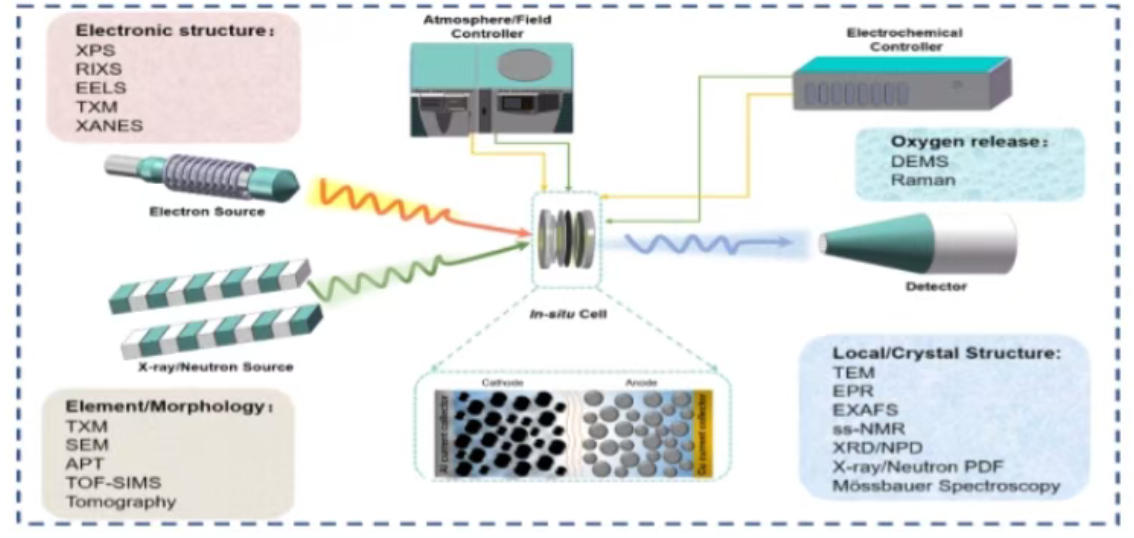
Abstract translation:
The electrification of transportation is an important factor in reducing global carbon dioxide emissions. However, this progress has been limited by concerns about the range of vehicles, which stem from the low specific energy of the most advanced energy storage devices used, which has been widely recognized. Therefore, further improving the specific energy of lithium-ion batteries (LIBs) is an inevitable requirement, among which the development of positive absorbing materials with high energy density, i.e. high specific capacity and/or high operating voltage is crucial. Correspondingly, a large amount of research work is being carried out globally, including several materials
However, for these materials, the increased operating voltage is a double-edged sword, as achieving high specific capacity is always accompanied by the redox process of oxygen elements, and the reversibility of this process is not satisfactory, which has a significant impact on the structural stability and electrochemical performance of the material. Therefore, understanding the failure mechanism of anionic redox chemistry and finding solutions to this problem is crucial for the practical application of these high-voltage materials.
Although there have been many research reports on the anionic redox chemistry of different materials, the corresponding reviews mainly focus on lithium rich cathode materials. Therefore, the review of high-voltage lithium cobalt oxide and high nickel cathode materials is still incomplete, and there is no unified understanding of their behavior under high voltage. This lack of comprehensive understanding hinders the further development and application of high-voltage positive plate materials.
Therefore, this review focuses on the similarities and differences in anionic redox chemistry among lithium cobalt oxide, lithium rich, and high nickel high-voltage cathode materials, emphasizing a unified mechanistic framework and related challenges and countermeasures. Sodium aims to provide guidance for future exploration of materials with anionic redox chemistry, thereby fully unleashing the potential of high-voltage lithium-ion batteries in various applications.
DO1:10.1039/d4cs00797brsc.li/chem-soc-rev
Top Issue 2
ACS Energy Letters (IF=22.0)
Synergistic control of interlayer interlayer spacing for P2 type layered oxide cathode materials with excellent rate performance
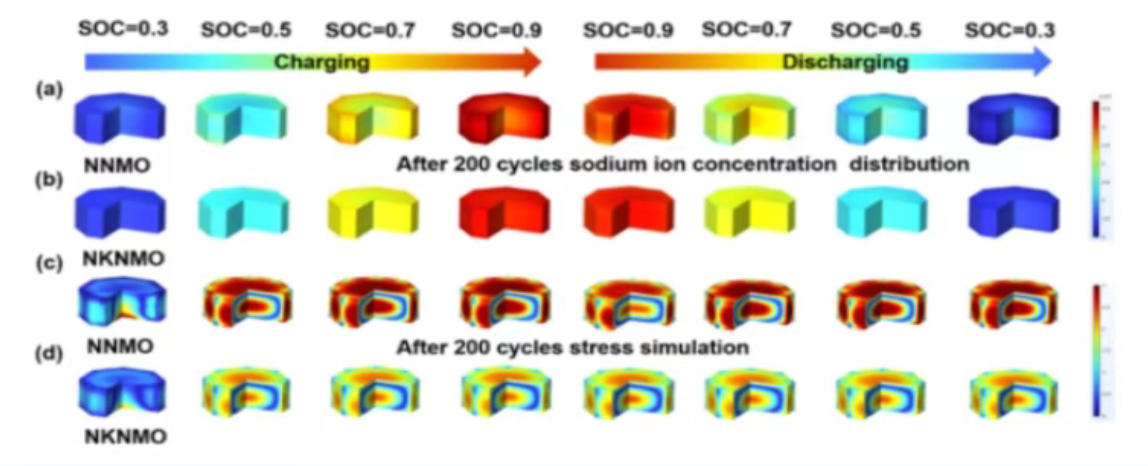
Abstract translation:
P2 type layered transition metal oxides have attracted much attention as positive electrode materials for sodium ion batteries (SIBs); However, during the process of sodium removal, they have limited capacity and unstable structure
This poses significant challenges for practical applications.
Here, sodium co regulates the interlayer and intralayer distances of transition metals (TM) by replacing sodium (Na) with potassium (K), thereby solving these problems and obtaining a stable structure, denoted as Nac.62Ko.osNio.3aMno.6702 (NKNMO). The potassium ion column promotes an increase in interlayer distance and a decrease in interlayer distance of transition metals, which is beneficial for the transport of sodium ions and stabilizes the structure. Theoretical calculations and electrochemical tests have shown that this P2 type positive electrode material exhibits excellent rate performance and enhanced anionic redox activity. Specifically, through the use of high-resolution two-dimensional X-ray diffraction, it was directly demonstrated that the harmful phase transition of NKNMO was alleviated and the lattice strain was significantly reduced during cycling at different magnifications.
A stable sodium storage lattice structure can prevent the collapse of layered structures, especially during high current density charging, thereby achieving excellent cycling stability. After 500 cycles at 3C rate, the capacity retention rate reached 95.99%. This work provides a basic understanding of material structure and important clues for the development of structurally stable high-performance sodium ion battery cathode materials.
https://doi.org/10.1021/acsenergylett.4c01520ACS Energy Lett.2024, 9, 3922-393
Top issue three:
Adv. Energy Mater (IF=29.4)
Gradient structure design induces rock salt phase interface and P2/P3 dual phase bulk structure to achieve long-term sodium ion storage of layered oxide cathode materials
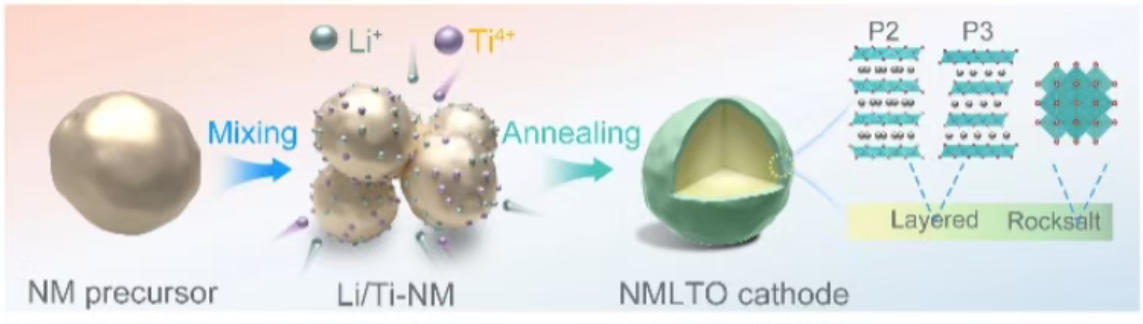
Abstract translation:
Layered transition metal oxides are the most promising positive electrode materials for sodium ion batteries (SIBs). However, due to irreversible phase transitions and intensified interfacial side reactions during the (de) sodiation process, these materials suffer from rapid capacity reduction and slow sodium ion migration kinetics. Here, a material with a coherent gradient architecture from the rock salt phase interface to the P2/P3 layered bulk heterostructure was prepared by precursor guided driven reaction method. This core-shell structure design reduces harmful phase transitions through interlocking effects, thereby improving the structural integrity of the resulting positive electrode material.
Specifically, the surface of rock salt is structurally robust, reducing interface parasitic reactions and stabilizing surface oxygen. With this unique design, the prepared positive electrode material has a discharge specific capacity of 94 milliampere hours per gram at a 5C rate in the voltage range of 2.0 to 4.3 volts, and exhibits excellent cycling stability, with a capacity retention rate of 76% after 1000 cycles. In addition, the gradient structure design induced by the precursor significantly improves the thermal stability of the positive electrode material, which is an additional advantage for the safety of sodium ion batteries. This work provides future guidance for designing high-performance positive electrode materials for advanced sodium ion batteries.
D01: 10.1002/aenm.202406184Adv. Energy Mater.2025, 2406184
The concentrated publication of three top tier papers is not only an authoritative certification of the scientific research strength of Na Yuan New Materials, but also an important milestone in the industrialization process of sodium positive electrode materials. As the core leading enterprise of positive electrode materials for sodium ion batteries, Na Yuan New Materials will build a technological moat with a forward-looking layout, and work together with global partners to usher in a new era of green energy.
The stars and the sea never stop. Na Yuan New Materials is willing to work side by side with industry colleagues, using the surging momentum of technological innovation to jointly write the high-quality development of the sodium electricity industry
The magnificent chapter of the exhibition!